Loading...


Search for
Search

PANAM VALVES
Precision-engineered instrumentation solutions for critical global infrastructure.
Headquarters
Ground Floor, St Edburgs Hall
Priory Road, Bicester, OX26 6BL
United Kingdom
© 2026 Panam Valves Ltd. All Rights Reserved.
Built for Extreme Pressure: A Closer Look at the PANAM HP Series Needle Valves
Inside the PANAM HP Series — Precision Flow Control Rated Up to 60,000 PSI
SR
Sejal Raina
Sales & Marketing
May 5, 2026 • 8 min read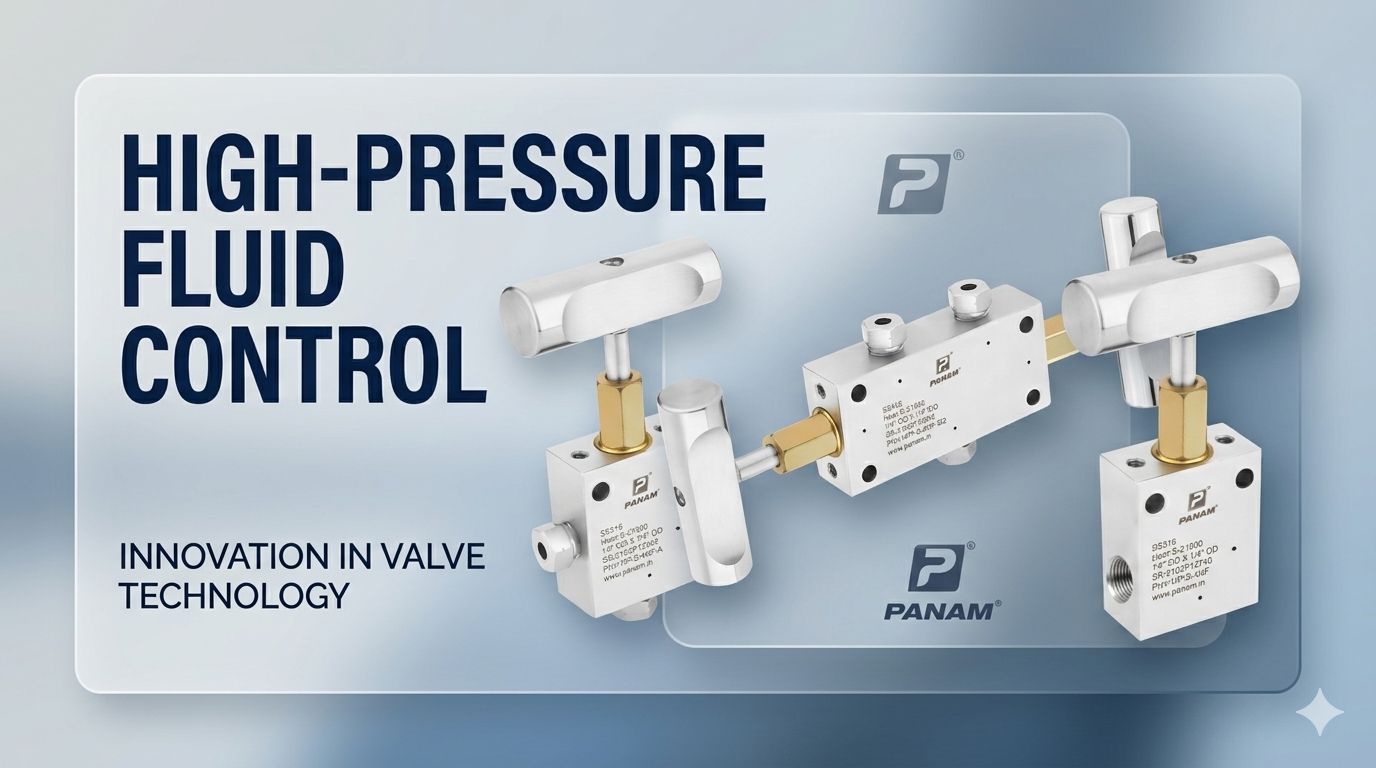
When pressure climbs past 30,000 PSI, ordinary flow control hardware stops being an option. Tolerances tighten, sealing systems get fussy, and the cost of getting it wrong climbs along with the gauge. The PANAM HP Series is engineered for exactly that environment — rugged, corrosive, and hazardous service from instrumentation duty all the way to 60,000 PSI (4,134 bar).
This is where a needle valve stops being a commodity and starts being a precision component. Browse the full PANAM needle valve range to see all series, connection types and pressure ratings.
First — What Does a Needle Valve Actually Do?
The mechanism is simple and elegant. A finely threaded stem drives a tapered, needle-shaped tip into a matching seat. As the stem turns, the gap between needle and seat shrinks — gradually, predictably, in proportion to stem rotation. That geometry is what gives needle valves their signature trait: smooth, near-linear flow modulation across many turns of the handle.
It is why they end up in instrumentation manifolds, sample loops, hydraulic test stands, and gauge isolation circuits. A needle valve is not built for speed — it is built for exactness.
The HP Series at a Glance — Five Pressure Tiers
Connection sizes run from ¼″ through 1″ across the line. End connections include NPT, BSPT, and BSPP threads, plus PANAM's medium-pressure and high-pressure cone-and-thread fittings — the standard for ultra-high-pressure tubing systems.
| Series | Pressure Rating | Typical Service |
|---|---|---|
| MP Series | Up to 6,000 PSI (414 bar) | Instrumentation, general process |
| HP-10K | Up to 10,000 PSI (690 bar) | Hydraulic test stands, HPUs |
| HP-20K | Up to 20,000 PSI (1,379 bar) | Wellhead, chemical injection |
| HP-40K | Up to 40,000 PSI (2,758 bar) | Waterjet, high-pressure research |
| HP-60K | Up to 60,000 PSI (4,134 bar) | Ultra-high-pressure, hydrogen |
What's Engineered Underneath
A few details separate a workhorse high-pressure needle valve from a glorified shut-off:
Non-rotating stem tip
The stem rotates on actuation but the tip does not — it translates straight into the seat. This protects the seating surface from galling and gives the operator a consistent feel turn after turn. Critical on proof-test rigs where the valve cycles many times per shift.
Fine-pitch thread
More turns per inch means smaller incremental flow changes per degree of rotation. For throttling, metering, and calibration bleed applications, this is what gives operators the resolution to set a flow and trust it stays set.
Live-loaded packing
Spring-energised packing maintains a consistent sealing load as the packing wears and as temperature cycles. It substantially extends the interval between repacking and reduces the leak events that come from packing that has relaxed over time.
Stem tip options
Standard needle tip suits most shut-off and throttling duties. Vee-notch tip gives a more linear Cv curve at low openings — suited to precise flow setting. Regulating tip extends the usable throttling range by slowing the rate of area increase at low lift.
Where the HP Series Earns Its Keep
Oil & Gas
On wellhead instrumentation, chemical injection skids, and high-pressure sampling systems, HP Series valves are supplied to meet NACE MR0175 / ISO 15156 and NACE MR0103 — the qualifications that matter when H₂S is on the line.
• Wellhead and Christmas tree instrumentation
• Chemical injection systems and umbilicals
• High-pressure gas sampling and analyser feeds
• Subsea and offshore control panels
Hydraulic Systems
On hydraulic test rigs and proof-test stands, repeatability and seat life dominate the spec. The non-rotating stem and fine-pitch thread design give operators the smooth, predictable handle feel that test work demands.
• Hydraulic test stands and proof-pressure rigs
• Hydraulic power units (HPUs)
• Actuator and cylinder control circuits
• High-pressure bleed and pressure regulation lines
Instrumentation
In analyser and metering circuits, the HP Series isolates instruments and modulates low flows without disturbing the upstream process. Vee or Regulating stem tips let you tune the valve to the measurement.
• Pressure gauge and transmitter isolation
• Calibration bleed and zero lines
• Analyser feed throttling
• Root isolation on instrument tappings
Materials & Temperature
Body and trim materials are matched to service — chloride-rich brines, sour gas, oxygen, hydrogen, and aggressive process chemistries are all in scope.
| Material | Suited Service |
|---|---|
| 316 Stainless Steel | General process, instrumentation, corrosive fluids |
| 316L SS | Low-carbon for weld heat-affected zone sensitivity |
| Duplex (2205) | Chloride-rich brines, offshore, high strength |
| Hastelloy C-276 | Highly aggressive chemistries, sour gas |
| Monel 400 | Hydrofluoric acid, seawater, reducing environments |
| Titanium | Seawater, offshore, oxygen-compatible service |
Packing & Temperature Range
| Packing | Temperature Range | Notes |
|---|---|---|
| PTFE | -65°F to +450°F (-54°C to +232°C) | Standard; low friction, easy cycling |
| Grafoil | -65°F to +1200°F (-54°C to +649°C) | High-temp; breaks in differently under frequent actuation |
| PEEK | -65°F to +550°F (-54°C to +288°C) | Chemical resistance, low creep |
Specifying with Confidence
Match the body material to the worst-case fluid, not the typical fluid.
A line that runs sweet service 95% of the time but sees an upset condition once a quarter is the line that fails on the 96th day. Specify for the excursion.
Pick the packing for the temperature and the cycling profile.
Grafoil handles heat better but breaks in differently than PTFE under frequent actuation. Confirm your expected cycle count and temperature range before selecting.
Don't oversize the orifice.
A bigger orifice gives you more flow but less resolution. If you're metering, the smallest orifice that meets your maximum-flow requirement is almost always the right answer. PANAM publishes Cv versus turns-open curves for every series — use them.
Quality, Testing and Traceability
Every PANAM HP Series valve is 100% factory tested to its maximum pressure rating with a no-detectable-leakage acceptance criterion. Materials ship in compliance with ASTM specifications and are verified by NABL-approved third-party laboratories. Heat code traceability is maintained throughout. Cleaning and packaging follow the PANAM PWI/5.7/21 standard.
For the full range of configurations, pressure tiers and connection options, visit the PANAM needle valve product page or speak to our team for application-specific sizing support.
Working with high-pressure instrumentation, hydraulics or hydrogen service?
Request an HP Series application review from the PANAM engineering team. We'll confirm the right pressure tier, stem tip, packing, and material grade for your specific media, temperature, and cycling profile — so you spec it right the first time.
At a Glance
• What a Needle Valve Does
• Five HP Pressure Tiers
• Non-Rotating Stem & Fine-Pitch Thread
• Oil & Gas / Hydraulics / Instrumentation
• Materials: SS316, Duplex, Hastelloy
• Packing & Temperature Selection
• 100% Factory Pressure Tested
PANAM HP Series Needle Valves
316 SS · Up to 60,000 PSI · NPT / BSPP / BSPT · NACE Compliant
Browse the range →